Hyperbolic Tesselations
Tesselations based on simplicial domains
Both, spherical space tesselations (aka polytopes) and Euclidean space tesselations,
base their reflection symmetry groups on simplicial fundamental domains. In 2D spherical geometry those are known as
Schwarz triangles, in 3D they are called Goursat tetrahedra.
In Euclidean space this restriction was relaxed in so far as parallel mirrors would be allowed,
i.e. ones which don't intersect anymore.
The submultiplicative number of the dihedral angle (i.e. the link mark) in such cases was set to ∞.
This results in an offshore vertex of the former simplicial fundamental domain, drifted far away to infinity.
But that's all what can happen. Now taking over this view onto hyperbolic space, already gives lots of stuff to deal with.
– Even though, it should be noted, that this still is not the end of the story, there are other possibilities too.
Besides from the shape and the size of the fundamental domain, for instance its extend to infinity ("cusps"), also the extend of the
tiles can be considered.
For Euclidean tilings, honeycombs, etc. there are 2 classes, one using only
finite tiles (polytopes of spherical geometry) but building up complexes which nonetheless fill all of Euclidean space,
or alternatively those other ones, which use additionally infinitely extended tiles, i.e. euclidean tilings, honeycombs, etc.
from one dimension less as building blocks within the next dimension. In hyperbolic space, there even is one case more:
- compact: hyperbolic tesselations using finite (spherical polytopial) tiles only
- paracompact: hyperbolic tesselations which additionally (to class 1) include lower dimensional euclidean tesselations as infinite tiles
- hypercompact: hyperbolic tesselations which additionally (to either class 1 or 2) include lower dimensional hyperbolic constituends
However, strictly speaking, those 3 terms in fact more relate to the property of the fundamental domain of kaleidoscopical construction, than to the
thereby obtained facets (tiles) themselves. This esp. will become relevant when dealing with non-convex tiles. That distintion then
relates to bounded domains, to infinitely size and still finite volume domains, and to infinite volumed domains respectively.
But, when dealing with convex tiles only, the above, much easier deducible description indeed coincides with that.
Finally, right from their definition, Dynkin symbols, both for the mere symmetry groups, and for the described polytopes or tesselations, are
essentially based on that simplicial restriction and thus not versatile outside that very scope.
(But attempts for more general Coxeter domains can be made too.)
A further class are laminates. These are built from infinite regions of a tesselation, which are made from compact
tiles only. Those regions further are bounded by some infinite (pseudo) facetings, which serve as reflection, glide-reflection, etc.
As such laminates belong to class 1. –
Note that these facets might become real ones within class 3: There such laminar regions could
occur between bollotiles (tiles of hyperbolic structure themselves). Clearly we should restrict here to cases, where these bollotiles
do have exactly the same curvature as the whole tesselation. Because then those behave like hemi-facets of spherical space:
One could consider the external, infinitely multiple self-blends of those tesselations,
which would just blend out these bollotiles. That is, these serve as mirrors, each reflecting the laminar region.
The such derived laminate accordingly is called the lamina-truncate of the un-blended structure.
Both these notions were introduced by W.Krieger.
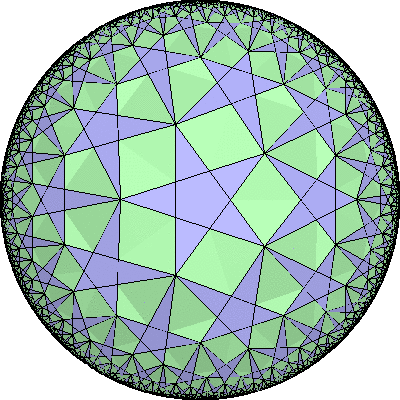
Further fun would occur with laminates in the non-uniform CRF realm. For instance when two different laminates have the same curvature as well as the same margin tiling,
because then instead of simply reflecting the laminate itself these could be used alternatingly instead, cf. the right picture with the mixture of
(4,6,4,6) and (3,∞,3,∞).
Just as for spherical geometry, the hyperbolic one has also a non-vanishing uniform curvature. Accordingly a circumradius here too
is well-defined. Only that this quantity would provide purely imaginary values for hyperbolics. In fact, the formulas for radius
derivation, based on a given Wythoffian Dynkin diagram (being implemented within
the spreadsheet, which is provided at the download page), would work here exactly the same.
----
 2D  Tilings (up)
----
In this dimension any Dynkin symbol of type oPoQo would be hyperbolic, whenever 1/P + 1/Q < 1/2 (or
equivalently (P-2)(Q-2) > 4).
(In fact ">" within the first formula would qualify spherical, and "=" would qualify euclidean.)
For convex cases, i.e. integral
line mark numbers, the single euclidean solution for a loop Dynkin symbol is o3o3o3*a; no spherical does exist.
Anything beyond thus qualifies as a symmetry group of hyperbolic space. As long as finite line mark numbers are used only,
for this dimension we remain within the above mentioned first class. – But even the general hyperbolic case for
oPoQoR*a can be formalized by 1/P + 1/Q + 1/R < 1 for any rational P,Q,R
(each >1),
thereby extending the above formula to cases with R<>2 as well.
With respect to the node markings we will have exactly the same cases as given explicitly in
that listing for the general Schwarz triangle oPoQoR*a (providing
cases and their general incidence matrices; although there, in addition for each of those general incidence matrix cases, so far only links to
spherical and euclidean space representants are provided).
Compact Tilings
(A nice applet for visualization of 2D hyperbolic tilings (as well as euclidean ones) is
tyler. In case make sure to check "hyperbolic".
In fact it was designed to work beyond triangular domains as well.)
In contrast to the situation of euclidean space tilings for both the spherical and hyperbolical tilings
the size of the tiles is fixed by the absolute geometry of the filled manifold, i.e. its curvature, and the to be used vertex figure.
For instance, let P0 be a vertex of xPoQo, let P1 be the center of an adjacent edge, and P2 the
center of an adjacent face (in fact a xPo), then the distances φ = P0P1, χ = P0P2,
and ψ = P1P2 depend on the absolute geometry of oPoQo via
cosh(φ) = cos(π/P) / sin(π/Q)
cosh(χ) = cot(π/P) · cot(π/Q)
cosh(ψ) = cos(π/Q) / sin(π/P)
Therefore xPoQo itself can be described as a tiling with edge length 2φ, having Q P-gons at each vertex, and the P-gons
will have a circumradius of χ and an inradius of ψ.
The only regular star-tesselations have the symmetries o-P-o-P/2-o, here P being an odd integer greater than 5.
All those star-tesselations would have density 3. (The case P = 5 already describes the spherical space tesselation or polyhedron
sissid respectively gad.)
In fact, x-P/2-o-P-o are derived as stellations of xPo3o.
Dually, the edge-skeletons of x-P-o-P/2-o and of x3oPo are the same.
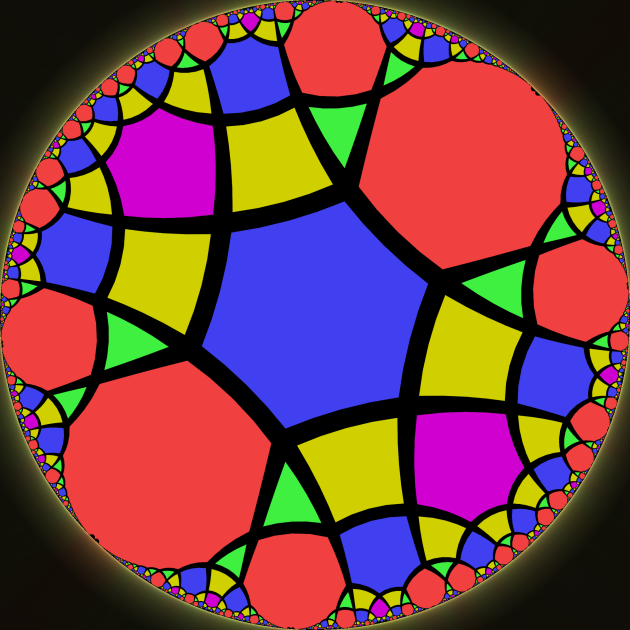
Non-regular other compact star-tesselations however do exist, cf. eg. siditetpeat.
(In fact, that examplified one occurs as a faceting of x5o4o,
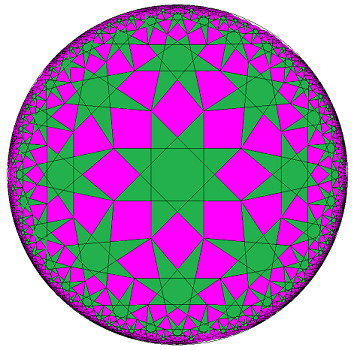
where the purple pentagrams are just inscribed into the pentagons and the green squares are simply its vertex figures.)
Or cf. the other shown example o8x8/3o3*a (which likewise is
inscribable, then into x8o3o).
Paracompact Tilings
As there is just a single 1D euclidean space tiling, aze, the only
wythoffian tilings of hyperbolic plane, which use euclidean tiles
in addition to polygons, are based on the reflection groups
oPoQoR*a, where still 1/P + 1/Q + 1/R < 1, but at least one of those link marks being infinite.
Here aze then will be understood to describe an horocyclic tile (a.k.a. apeirogon).
(For tilings with more general fundamental domains cf. Coxeter domains.)
----
 3D  Honeycombs (up)
----
Compact Honeycombs
Here the restriction to finite tiles is much more effective, at least if being considered with respect to non-product honeycombs.
For convex cases (integral line mark numbers) we only have the following 9 irreducible symmetry groups, resp. the
therefrom derived listed Wythoffian hyperbolic honeycombs.
*) These figures occur only as alternations. An all unit edged representation does not exist.
Trying to extend the class with linear Dynkin diagrams into non-convex realms, i.e. asking for compact regular star-honeycombs,
would come out to be hopeless either. In fact, the actual choice of any Kepler-Poinsot polyhedron
(as well for cell as for vertex figure) produces spherical curvatures only.
– But this would not bother the other (non-linear) types of Dynkin diagram structures (nor non-compact linears)!
| So far just some random star examples... |
x5/2o5o3o5*a
o5/2o5x3o5*a
x5/2x5o3o5*a
x5/2o5x3o5*a
x5/2o5o3x5*a
o5/2o5x3x5*a
x5/2x5x3o5*a - [Grünbaumian]
x5/2x5o3x5*a - [Grünbaumian]
x5/2o5x3x5*a
x5/2x5x3x5*a - [Grünbaumian]
|
x5o3o3o5/2*b - ditdih
o5x3o3o5/2*b
o5o3x3o5/2*b
o5o3o3x5/2*b
x5x3o3o5/2*b
x5o3x3o5/2*b
x5o3o3x5/2*b
o5x3x3o5/2*b
o5x3o3x5/2*b - [Grünbaumian]
o5o3x3x5/2*b
x5x3x3o5/2*b
x5x3o3x5/2*b - [Grünbaumian]
x5o3x3x5/2*b
o5x3x3x5/2*b - [Grünbaumian]
x5x3x3x5/2*b - [Grünbaumian]
|
Also to class 1 would belong additionally all the honeycomb products
of any 2D hyperbolic tiling with (an appropriate hyperbolic space version of) aze.
This is due to the fact that in this product neither of the full-dimensional elements themselves (considered as bodies)
remain true elements of the product (although those could be seen as being pseudo elements thereof).
More generally the laminates belong here. For quite long the only known uniform lamina-truncates
(cf. definition) are lamina-trunc( x4x3o8o ) and
lamina-trunc( o8o4x *b3x ). Within 2023 D. Sebald came up with 2 additional ones,
then also showing up their relations to Coxeter domains. At the end of 2025 he further showed up with
lamina-trunc( x3o4x8o ) too.
Already in 1997 W. Krieger found an infinite series of uniform, pyritohedral vertex figured honeycombs
belonging here as well (each featuring 8 cubes and 6 p-gonal prisms per vertex).
Other singular cases would be spd{3,5,3} (with 2 does, 6 paps,
and 6 ikes per vertex) and pd{3,5,3} (with 4 does
and 12 paps per vertex), as detailed under subsymmetric diminishings.
In early 2021 a compact non-Wythoffian though uniform hyperbolic was found by a guy calling himself "Grand Antiprism",
the octsnich, having 2 octs and 8 snics per vertex.
In reply W. Krieger found x3o:s3s4s, a compact non-Wythoffian with 32 tets and 6 octs
per vertex, the vertex figure of which happens to be snic. She then even found that its rectification o3x:s3s4s
and its truncation x3x:s3s4s, then each providing snics for cells, would be likewise valid.
In 2022 the author extrapolated these moreover into the general ones x3o:s3sPs, o3x:s3sPs,
and x3x:s3sPs, then surely mostly hypercompact each.
In late 2025 "planetN9ne" found in a related sense a further compact honeycomb, which later became understood as
lt-pex-x3o3o5o5*a (i.e. a lamina-truncate
of a partial Stott expansion
by interlacing x x5o5o and mirroring at the mid-prism manifold), either of which lamination components however are hypercompact.
Paracompact Honeycombs
Irreducible 3D hyperbolic reflectional symmetry groups within class 2, with finite integral link marks only, would group into the following
classes, which would include euclidean tilings in addition to spherical space tiles.
Those noncompact hyperbolic groups can be considered over-extended forms, like the affine groups, adding a second node in sequence to the
first added node, with letter names marked up by a '++' superscript.
*) These figures occur only as alternations. An all unit edged representation does not exist.
**) Although being rescalable to equal edge lengths, those figures are only scaliform.
E.g. the linear diagrams oPoQoRo, in order to be at most paracompact, in general would require to bow under both,
(P-2)(Q-2) ≤ 4 and (Q-2)(R-2) ≤ 4. Further, those numbers again can be used to derive the according geometry: Any
xPoQoRo consists of xPoQo-cells only, those having edges of length 2φ, an circumradius of χ, and an inradius of ψ,
where
cosh(φ) = cos(π/P) sin(π/R) / sin(π/hQ,R)
cosh(ψ) = sin(π/P) cos(π/R) / sin(π/hP,Q)
cosh(χ) = cos(π/P) cos(π/Q) cos(π/R) / sin(π/hP,Q) sin(π/hQ,R)
with:
cos2(π/hP,Q) = cos2(π/P) + cos2(π/Q)
(The last equation clearly evaluates into
hP,2 = P,
h2,Q = Q,
h3,3 = 4,
h3,4 = h4,3 = 6,
h3,5 = h5,3 = 10,
h3,6 = h4,4 = h6,3 = ∞.
Geometrically this number is related to the Petrie polygon of each of the corresponding regular polyhedra or tilings,
i.e. their largest regular shadow polygon.)
Surely there do exist 3D paracompact lamina-truncates too.
E.g. lamina-trunc( o3x3x4o4*a3*c ).
Hypercompact Honeycombs
As any neither compact nor paracompact hyperbolic honeycomb would be hypercompact, those clearly have infinite count.
So there cannot be a complete listing, not even tentatively. Only a few, randomly selected examples might follow here.
°) These figures not only allow for an all unit edged representation but then even become uniform.
**) Although being rescalable to equal edge lengths, those figures are only scaliform.
Although x4o3o4x4*b is itself not quasiregular
it still allows for rectification as well as truncation, as all of its faces are alike squares.
This then results in the still hypercompact CRF honeycombs rect( x4o3o4x4*b )
and trunc( x4o3o4x4*b ) respectively,
which then incorporate Johnson solids for (some of its) cells.
(For honeycombs with more general fundamental domains cf. Coxeter domains.)
And starry hypercompact honeycombs do exist as well.
Just to mention an in 2023 provided example found by B. Klein:
(idtid+tidect).
In fact, this still uniform honeycomb comes out to be an edge-faceting
of the likewise starry wythoffian compact honeycomb
o3x4o4o5/2*b. But even regular starry hypercompact honeycombs do exist, eg.
siddoh or its dual fipech.
----
 4D  Tetracombs (up)
----
Compact Tetracombs
Dwelling within class 1 only, is equally restrictive here. Potential irreducible symmetries are:
Only the convex symmetries are exhausted within the table.
This already is enough to show that here there are exactly 5 convex regulars and 4 regular star-tetracombs within class 1.
Beyond 4D, there will be no irreducible symmetry within class 1 anymore.
Within this dimension as well lamina-truncate uniforms are known, contit and odipt,
which btw. are the only known non-regular dual pair, both of which are uniform.
Paracompact Tetracombs
The potential irreducible convex cases within class 2 are provided by the following groups.
Those provide 2 more regular figures.
Hypercompact Tetracombs
As any neither compact nor paracompact hyperbolic tetracomb would be hypercompact, those clearly have infinite count.
So there cannot be a complete listing, not even tentatively. Only a few, randomly selected examples might follow here.
*) Although being rescalable to equal edge lengths, those figures are only scaliform.
Additionally a still hypercompact lamina-truncate uniform is known here,
the lamina-truncate( x3x4x3x8o ).
Although o4x4o3*a4x4o3*a is itself not quasiregular
it still allows for rectification as well as truncation, as all of its faces are alike squares.
Because additionally its edges had been symmetry equivalent, it becomes clear that
thoss then result in still hypercompact scaliform tetracombs rect( o4x4o3*a4x4o3*a )
and trunc( o4x4o3*a4x4o3*a ) respectively,
which then not only incorporate Johnson solids for (some of its) cells,
but also have an in turn truely scaliform facet type.
----
 5D  Pentacombs (up)
----
Just providing irreducible convex symmetries. In class 1 (compact ones) there is none.
Paracompact Pentacombs
In class 2 we have only the groups
Hypercompact Pentacombs
Again those clearly have infinite count. So there cannot be a complete listing, not even tentatively.
Only a few, randomly selected examples might follow here.
----
 6D  Hexacombs (up)
----
Just providing irreducible convex symmetries. In class 1 (compact ones) there is none.
Paracompact Hexacombs
In class 2 we have only the groups
Hypercompact Hexacombs
Again those clearly have infinite count. So there cannot be a complete listing, not even tentatively.
Only a few, randomly selected examples might follow here.
----
 7D  Heptacombs (up)
----
Just providing irreducible convex symmetries. In class 1 (compact ones) there is none.
Paracompact Heptacombs
In class 2 we have only the groups
----
 8D  Octacombs (up)
----
Just providing irreducible convex symmetries. In class 1 (compact ones) there is none.
Paracompact Octacombs
In class 2 we have only the groups
Hypercompact Octacombs
Again those clearly have infinite count. So there cannot be a complete listing, not even tentatively.
Only a few, randomly selected examples might follow here.
----
 9D  Enneacombs (up)
----
Just providing irreducible convex symmetries. In class 1 (compact ones) there is none.
Paracompact Enneacombs
In class 2 we have only the groups
Hypercompact Enneacombs
Again those clearly have infinite count. So there cannot be a complete listing, not even tentatively.
Only a few, randomly selected examples might follow here.