compound of 8 oct
© ©
(at margins)
- between {3} and {3}: arccos(-1/3) = 109.471221°
links

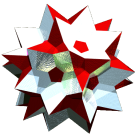
| Acronym | daso (old: doso) |
| Name |
disnub octahedron, compound of 8 oct |
| |
| Circumradius | 1/sqrt(2) = 0.707107 |
| Inradius | 1/sqrt(6) = 0.408248 |
| Vertex figure | [34] |
|
Dihedral angles
(at margins) |
|
| Confer | |
|
External links |
|
This compound has rotational freedom. Starting at φ = 0° with a completely coincident overlay of 8 octahedra, rotating 2 octahedra each, thought of as 3-fold antiprisms, around their common axis in opposite directions, and thereby passing at φ = 60° at a double cover of sno.
Bases of those 3-fold antiprisms pairwise fall into coincident face planes. So either they can be considered separately (type A); or they are considered as (rotated) 2-triangle-compounds (type B).
This also is a compound of 2 dissit (both tetrahedral subsets are used - type C).
For an intermediate state of φ the lateral triangles too become coplanar, and thus can be considered as (rotated) 2-triangle-compounds. That special case is called hidso (hexagrammattic disnub octahedron). (J. Bowers further uses idso (inner ...) for smaller values of φ, resp. odso (outer ...) for greater values.)
(Type A)

 48 |  2  2 |  3  1 || 1
----+-------+-------++--
  2 | 48  * |  1  1 || 1
  2 |  * 48 |  2  0 || 1
----+-------+-------++--
  3 |  1  2 | 48  * || 1
  3 |  3  0 |  * 16 || 1
----+-------+-------++--
♦ 6 |  6  6 |  6  2 || 8
(Type B)

 48 |  2  2 |  3 1 || 1
----+-------+------++--
  2 | 48  * |  1 1 || 1
  2 |  * 48 |  2 0 || 1
----+-------+------++--
  3 |  1  2 | 48 * || 1
  6 |  6  0 |  * 8 || 2
----+-------+------++--
♦ 6 |  6  6 |  6 2 || 8
(Type C)

  48 |  2  2 |  3  1 || 1
-----+-------+-------++--
   2 | 48  * |  1  1 || 1
   2 |  * 48 |  2  0 || 1
-----+-------+-------++--
   3 |  1  2 | 48  * || 1
   3 |  3  0 |  * 16 || 1
-----+-------+-------++--
♦ 24 | 24 24 | 24  8 || 2
© 2004-2024 | top of page |